





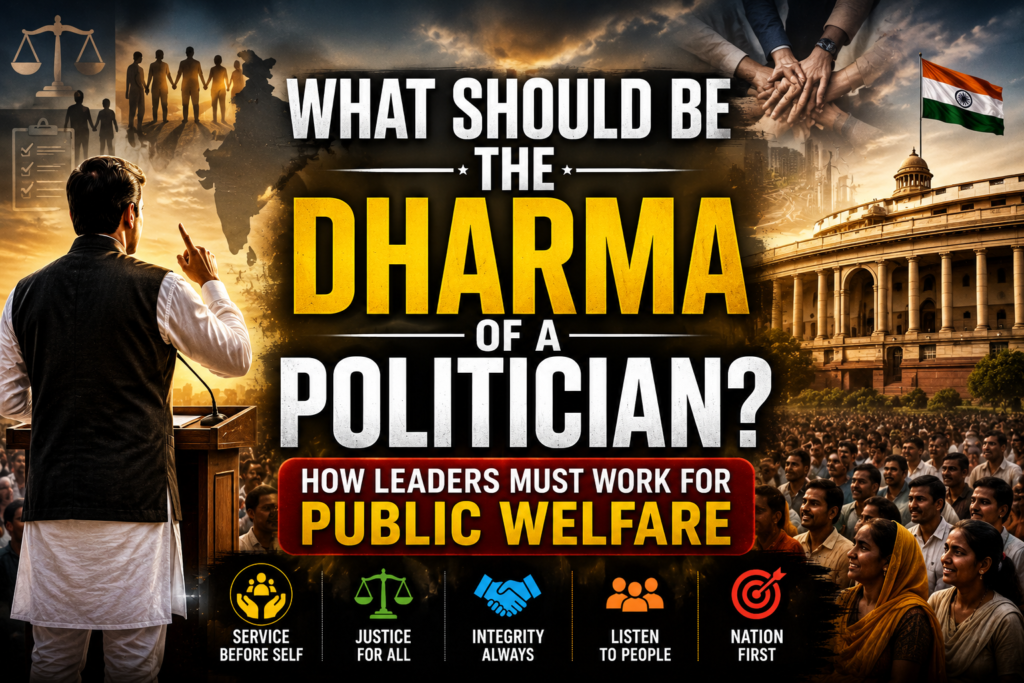
Discover the true dharma of a politician and how ethical leadership, honesty, and public service can transform society and create lasting public welfare.
Politics is one of the most powerful instruments for shaping society. A politician is not merely a person who contests elections or holds public office; they are entrusted with the responsibility of representing people’s hopes, solving their problems, and building a better future. In Indian philosophy, the concept of “Dharma” means duty, righteousness, and moral responsibility. Therefore, the dharma of a politician is not about power, status, or personal gain—it is about service, sacrifice, and working for the welfare of the people. Dharma of a Politician …
In today’s world, where politics often gets associated with corruption, selfish motives, and division, understanding the true dharma of a leader becomes more important than ever.
1. A Politician’s First Dharma: Service to the People
The foundation of politics should always be public service. A politician is chosen by the people to serve them—not to rule over them.
A true leader listens to:
- the struggles of ordinary citizens,
- the needs of the poor,
- the aspirations of youth,
- and the concerns of every section of society.
Public office is not a privilege; it is a responsibility.
The best politicians are those who ask:
“How can I help my people?” instead of “How can I help myself?”
2. Honesty and Integrity Must Be Non-Negotiable
Without honesty, leadership loses its moral authority.
A politician’s dharma includes:
- being truthful,
- avoiding corruption,
- respecting public money,
- and making transparent decisions.
When leaders misuse power for personal benefit, public trust collapses.
A nation becomes strong only when its leaders are trustworthy.
Integrity is not a slogan—it is a daily practice.
3. Equality and Justice for All . Dharma of a Politician …
A true leader must rise above:
- caste,
- religion,
- language,
- region,
- and personal bias.
The duty of a politician is to treat every citizen equally.
Justice must not depend on influence or wealth.
A politician’s dharma is fulfilled when every citizen feels:
“My leader stands for me.”
That is real democracy.
4. Listening Is More Important Than Speaking
Many politicians focus on speeches, but great leaders focus on listening.
A good politician:
- visits people,
- understands local issues,
- accepts criticism,
- and remains connected to ground reality.
Listening builds trust.
Disconnected leadership creates frustration.
People want leaders who understand their pain—not just their votes.
5. Long-Term Vision Over Short-Term Politics
True leadership is not about winning the next election.
It is about building:
- better schools,
- stronger healthcare,
- clean cities,
- job opportunities,
- and sustainable development.
A politician’s dharma is to think:
“What legacy will I leave behind?”
Short-term politics divides people.
Long-term vision unites generations.
6. Courage to Take Difficult Decisions
Leadership demands courage.
Sometimes a politician must make difficult decisions for the greater good—even when they are unpopular.
Examples:
- fighting corruption,
- reforming systems,
- standing against injustice,
- protecting national interest.
A leader without courage becomes a follower of public mood.
A true leader guides society.
7. Compassion and Humanity
Politics without compassion becomes mechanical.
A leader must feel:
- the pain of a farmer,
- the fear of an unemployed youth,
- the struggles of women,
- the concerns of senior citizens.
Empathy creates humane policies.
When politicians understand human suffering, governance becomes meaningful.
8. Accountability Is Essential
Power without accountability is dangerous.
A politician should be answerable to:
- the Constitution,
- the law,
- and the people.
They must accept:
- feedback,
- criticism,
- and responsibility for failures.
Blaming others is easy.
Owning mistakes is leadership.
9. Nation Before Self
The highest dharma of a politician is putting the nation first.
Not:
- party before nation,
- personal ambition before country,
- or ego before public good.
A true leader asks:
“What is best for my country?”
That mindset creates statesmen—not just politicians.
10. Inspiring the Next Generation
A leader’s actions influence society.
Young people learn values by watching public figures.
If politicians show:
- honesty,
- discipline,
- humility,
- and dedication,
they inspire future generations.
Leadership is not only about governing today.
It is about shaping tomorrow.
Lessons from Great Leaders
History remembers leaders who served humanity:
- Mahatma Gandhi taught service and sacrifice.
- Dr. APJ Abdul Kalam taught humility and vision.
- Nelson Mandela taught forgiveness and courage.
- Abraham Lincoln taught equality and perseverance.
Their greatness came not from power—but from purpose.
That is political dharma.
Why Modern Politics Needs Dharma
Today society faces:
- polarization,
- corruption,
- misinformation,
- and declining trust.
The solution is not more politics.
The solution is better politics rooted in dharma.
When leaders act ethically:
- society becomes peaceful,
- governance improves,
- and trust returns.
Dharma is not outdated.
It is the future of politics.
Final Thoughts
A politician’s true dharma is simple:
Serve honestly. Lead fearlessly. Work selflessly. Protect justice. Put people first.
Politics should not be a path to personal power.
It should be a path to public welfare.
When leaders remember this, nations prosper.
And when they forget it, societies suffer.
The world does not need more politicians.
It needs more true leaders.
Recommend for you : What Is the True Duty of Parents? A Complete Guide to Raising Children With Values, Discipline, and Love
Follow me : Instagram Facebook Twitter linkedin Pinterest
For Know More : Explains the role of morality, accountability, and ethical responsibility in political governance


2 Comments on “What Should Be the Ideal Dharma of a Politician for a Fair and Powerful Society”
Comments are closed.