




Patni Dharma in Hindu Tradition: Meaning, Duties, and Ancient Interpretations. Eternal Religion
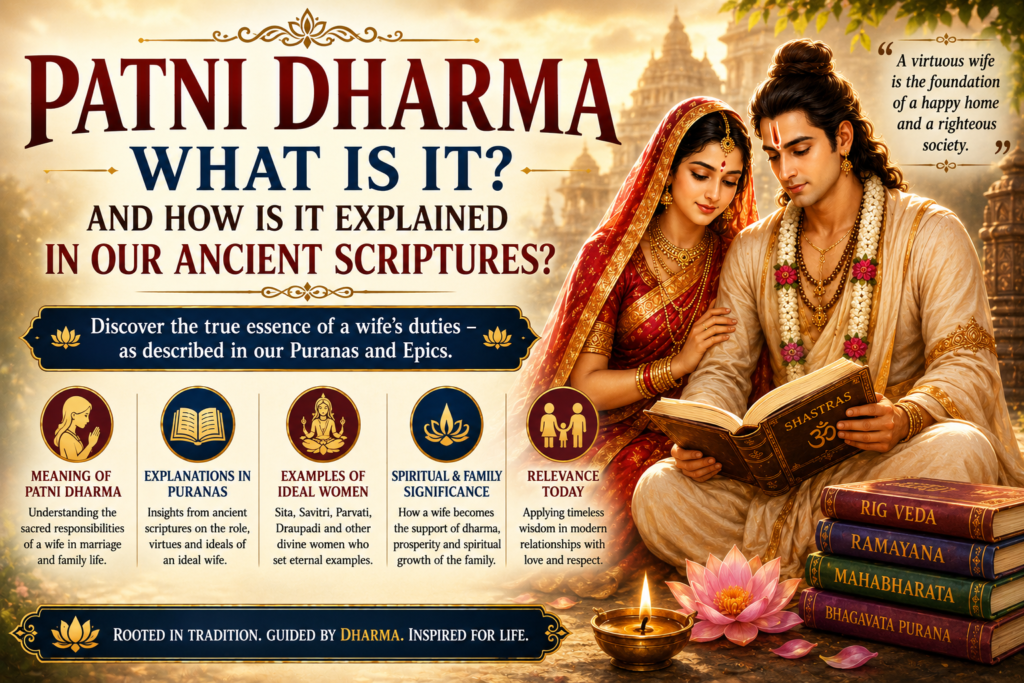
In Indian culture and Hindu philosophy, the concept of “Patni Dharma” holds deep spiritual, emotional, and social significance. The word “Patni” means wife, and “Dharma” means duty, righteousness, or moral responsibility. Together, Patni Dharma refers to the ideals, responsibilities, virtues, and conduct expected from a wife within married life according to ancient Hindu scriptures and traditions. Eternal Religion
However, Patni Dharma is not merely about obedience or household duties. In the broader spiritual context of Hinduism, it symbolizes partnership, sacrifice, mutual respect, loyalty, and the preservation of family values. Ancient scriptures describe the wife as the “Ardhangini,” meaning half of the husband’s soul, indicating that marriage is considered a sacred union of two equal spiritual partners.
This article explores the meaning of Patni Dharma and how it has been interpreted in Hindu Puranas, epics, and traditional scriptures.
Meaning of Patni Dharma.
Patni Dharma is often understood as the moral and spiritual responsibilities of a wife toward her husband, family, and society. In traditional Hindu thought, marriage is not simply a social contract but a sacred bond created for spiritual growth, family harmony, and continuation of dharma.
Ancient texts emphasize that a wife should possess qualities such as:
- Loyalty and faithfulness
- Compassion and patience
- Respect for elders
- Dedication toward family welfare
- Emotional support for her husband
- Spiritual partnership in religious duties
At the same time, scriptures also state that the husband has equal responsibilities toward his wife. Therefore, Patni Dharma was never intended to be one-sided domination but a system of mutual responsibility.
Patni as “Ardhangini”
One of the most important concepts found in Hindu scriptures is that a wife is the “Ardhangini” of her husband. This means she is not separate but an essential part of his life and existence.
According to traditional beliefs:
- A man is considered incomplete without his wife.
- Religious rituals in Hinduism often require the presence of both husband and wife.
- The wife participates equally in spiritual merit earned through righteous actions.
This concept elevates the status of women within household life and portrays marriage as a divine partnership rather than a hierarchical relationship.
Patni Dharma in the Ramayana, Eternal Religion
The Ramayana provides one of the most famous examples of Patni Dharma through the character of Sita, wife of Lord Rama.
Sita is often portrayed as the ideal wife because of her devotion, sacrifice, purity, and unwavering support toward her husband. When Lord Rama was exiled to the forest for fourteen years, Sita voluntarily chose to accompany him despite royal comforts being available to her.
Her actions reflected several traditional ideals:
- Standing beside her husband during hardship
- Maintaining dignity under difficult circumstances
- Remaining devoted despite suffering
- Preserving moral integrity
However, modern interpretations also recognize Sita as a symbol of strength, courage, and self-respect. She challenged injustice and upheld her dignity throughout her life.
Thus, the Ramayana presents Patni Dharma not only as service but also as inner strength and moral resilience.
Patni Dharma in the Mahabharata
The Mahabharata offers more complex and realistic examples of marital duties and relationships. Draupadi, wife of the Pandavas, is one of the strongest female characters in Hindu literature.
Draupadi demonstrated:
- Intelligence and political understanding
- Courage in times of crisis
- Devotion toward her family
- Fearless opposition to injustice
Unlike passive portrayals, Draupadi openly questioned wrongdoing in royal assemblies and defended her dignity. Her character shows that Patni Dharma does not mean silent suffering but includes self-respect and moral courage.
The Mahabharata also teaches that husbands must honor and protect their wives. Disrespect toward women is repeatedly shown as a cause of destruction and downfall.
Patni Dharma in Hindu Puranas
Several Hindu Puranas discuss the role of wives and ideal womanhood through stories of divine figures and devoted women.
Goddess Parvati
Goddess Parvati, wife of Lord Shiva, symbolizes devotion, determination, and spiritual strength. She performed intense penance to attain Shiva as her husband and later became an equal spiritual force beside him.
Their relationship represents balance between masculine and feminine energies.
Savitri and Satyavan
The story of Savitri is one of the most celebrated examples of devotion and intelligence. When her husband Satyavan died, Savitri confronted Yama, the God of Death, and through wisdom and determination brought her husband back to life.
This story portrays Patni Dharma as:
- Loyalty
- Wisdom
- Courage
- Spiritual power
Anasuya
Anasuya is remembered for her purity, devotion, and spiritual greatness. She became an example of ideal womanhood due to her humility and dedication toward family and righteousness.
Spiritual Importance of Marriage
In Hindu philosophy, marriage is considered a sacred samskara or spiritual sacrament. Husband and wife are believed to assist each other in fulfilling life’s four major goals:
- Dharma (righteousness)
- Artha (prosperity)
- Kama (desires and emotional fulfillment)
- Moksha (spiritual liberation)
Therefore, Patni Dharma is deeply connected with spiritual progress and family harmony.
Ancient texts often describe the wife as:
- The protector of household peace
- The emotional foundation of the family
- A guide for future generations
- A participant in religious and charitable acts
Modern Perspective on Patni Dharma
In modern times, the understanding of Patni Dharma has evolved significantly. Today, many people interpret it not as blind sacrifice but as mutual respect, emotional partnership, equality, and shared responsibilities.
Modern interpretations emphasize that:
- Marriage should be based on equality and understanding.
- Both husband and wife have duties toward each other.
- Respect, trust, and communication are essential.
- Women have the right to dignity, independence, and personal growth.
Thus, contemporary society views Patni Dharma as a balanced relationship where both partners support each other emotionally, socially, and spiritually.
Misinterpretations and Social Reality
Over time, some traditional ideas were misused to suppress women or justify inequality. However, many scholars argue that ancient scriptures originally emphasized harmony, respect, and cooperation rather than oppression.
In many Hindu texts:
- Women are worshipped as symbols of divine energy or Shakti.
- Mothers and wives are given high spiritual respect.
- Family prosperity is linked with the happiness and dignity of women.
Therefore, understanding Patni Dharma requires careful interpretation of scriptures within their spiritual and cultural context.
Conclusion
Patni Dharma in Hindu tradition is a profound concept that goes beyond household responsibilities. Ancient scriptures describe a wife as a spiritual companion, protector of family values, and equal participant in life’s journey. Through characters like Sita, Draupadi, Savitri, and Parvati, Hindu literature presents different dimensions of devotion, courage, wisdom, sacrifice, and dignity.
While traditional interpretations focused heavily on duties and loyalty, modern society increasingly understands Patni Dharma as mutual respect, partnership, and emotional equality between husband and wife.
Ultimately, the true essence of Patni Dharma lies not in submission, but in maintaining harmony, love, trust, and righteousness within married life.
Recommended For You : The Significance of Lord Shiva ’s Different Names
Follow me : Instagram Facebook Twitter linkedin Pinterest
Fore more : Hindu Marriage (overview of duties, roles, traditions)